 | By: Koen VerbeeckProblem
At the time of writing, SQL Server 2016 preview (CTP 2.2) has been released and it contains a few exciting changes for SQL Server Reporting Services (SSRS). One of the new additions is a new chart type: the treemap. This tip will give an introduction on how to create a treemap graph.
SolutionTest Data
First of all, we need data for our treemap. In the tip Retrieving file sizes from the file system using Power Query it is explained how you can use Power Query to extract the file sizes of all the files in a folder and its subfolders. The resulting data looks like this:
read on from the above link
|
Wednesday, September 16, 2015
Create a Treemap Graph in SQL Server Reporting Services 2016 by Koen Vereeck
https://www.mssqltips.com/sqlservertip/4023/create-a-treemap-graph-in-sql-server-reporting-services-2016/

Tuesday, September 1, 2015
Parsing all the files in a directory using PowerShell by Brian Lelley
 | By: K. Brian Kelley https://www.mssqltips.com/sqlservertip/2754/parsing-all-the-files-in-a-directory-using-powershell/ Problem
I want to parse all the files in a given directory using PowerShell. I'm looking for a particular bit of information and need to search for it in all the files. Is there an easy way to do this? Check out this tip to learn more.
Solution
Yes, there is. PowerShell is very powerful because it:
As a result, looping through a list of files to find a particular text string (or several text strings) is easy to do. For instance, consider the output from this previous tip where we audited for the members of the sysadmin role across multiple SQL Servers. This PowerShell script produces a text file per SQL Server instance. This is the perfect scenario for parsing for a particular group, such as BUILTIN\Administrators.
First, let's start by defining a variable containing a path to our directory as well as another variable, an object that is an array list (this is what New-Object System.Collections.ArrayList does), to hold our findings.
$fileDirectory = "c:\scripts\reports";
$parse_results = New-Object System.Collections.ArrayList;
Now we'll need a foreach loop combined with a Get-ChildItem cmdlet call to get a list of all the files in the directory.
# Use a foreach to loop through all the files in a directory.
# This method allows us to easily track the file name so we can report
# our findings by file.
foreach($file in Get-ChildItem $fileDirectory)
{
    # Processing code goes here
}
This part so far is pretty straight forward. Now, to be able to parse the files, we will want to use the switch command. The switch command in PowerShell is similar in function to the same command in other languages. You can think of it as being capable of stacking multiple IF statements together. This is what goes where we have the comment "# Processing code goes here" in the previous block.
# We will need to tell the Switch command exactly where to parse, so we'll put together
# the full file path.
$filePath = $fileDirectory + "\" + $file;
# parse all files using a regular expression
Switch -regex (Get-Content -path $filePath)
{
    # send the counter to $null so it doesn't display on screen
        'BUILTIN\\Administrators' { $parse_results.add($file.name + " >  " + $switch.current `
        + "`r`n") > $null  }
}
Note that for each pattern of a regular expression in single quotes followed by the curly braces, we have an evaluation. In this case I'm only looking for one case, when BUILTIN\Administrators is present (the backslash is doubled since we're using a regular expression and the backslash is an escape character). If I was looking for Users, I could add another line to parse this as well.
As to exactly what is being done, when the Switch statement detects a line that matches the condition I've specified, the line contains BUILTIN\Administrators, it's adding another entry to my array list. The entry will be a concatenated string of the file name where the text was detected, along with the entire line (that's what $switch.current refers to). Once all this is done, all that's left to do is write out what was captured. That's actually the reason for the "`r`n" added to the end of each string. That puts a carriage return/new line at the end of the string so that it'll output properly.
Our finished script looks like this:
$fileDirectory = "c:\scripts\reports";
$parse_results = New-Object System.Collections.ArrayList;

# Use a foreach to loop through all the files in a directory.
# This method allows us to easily track the file name so we can report
# our findings by file.
foreach($file in Get-ChildItem $fileDirectory)
{
    # We will need to tell the Switch command exactly where to parse, so we'll put together
    # the full file path.
    $filePath = $fileDirectory + "\" + $file;
    # parse all files using a regular expression
    Switch -regex (Get-Content -path $filePath)
    {
      # send the counter to $null so it doesn't display on screen
      'BUILTIN\\Administrators' { $parse_results.add($file.name + " >  " + $switch.current `
        + "`r`n") > $null  }
    }
}

write-host $parse_results;
And the output will look like this for a couple of files that I have in the directory:
localhost,5555_sysadmins.txt > BUILTIN\Administrators localhost_sysadmins.txt > BUILTIN\Administrators |
Friday, April 3, 2015
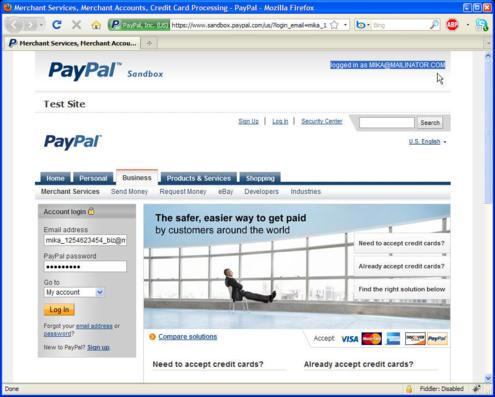
Introduction to PayPal for C# - ASP.NET developers
http://www.codeproject.com/Articles/42894/Introduction-to-PayPal-for-C-ASP-NET-developers
ayPal moved over 60 billion dollars between accounts which is, you’ll agree, a respectable amount. And also, all trends show that this growth will continue – with huge number of new accounts (over 184 million accounts in 2008 compared to 96.2 million in 2005), with a new platform named

Introduction
PayPal is probably one of the first things that gets mentioned once you start discussion on online payments. It’s not so without reason – in 2008, PPayPal X, and with more cool applications that involve paying (like Twitpay), you can bet that PayPal is here to stay. So, how can you join the whole PayPal Development movement?
Unfortunately, I would say – not so easily. When I first started with PayPal integration - it was hard, really hard. If you wish to see what I mean, just jump to the PayPal Developer Center. There is no way you’ll easily fish out what you need from that site if you are a PayPal newbie; simply - there are too many links, too many resources, and too many mixings of important and not-so-important information. So, how should you start?
Getting Started with PayPal...
Subscribe to:
Posts (Atom)